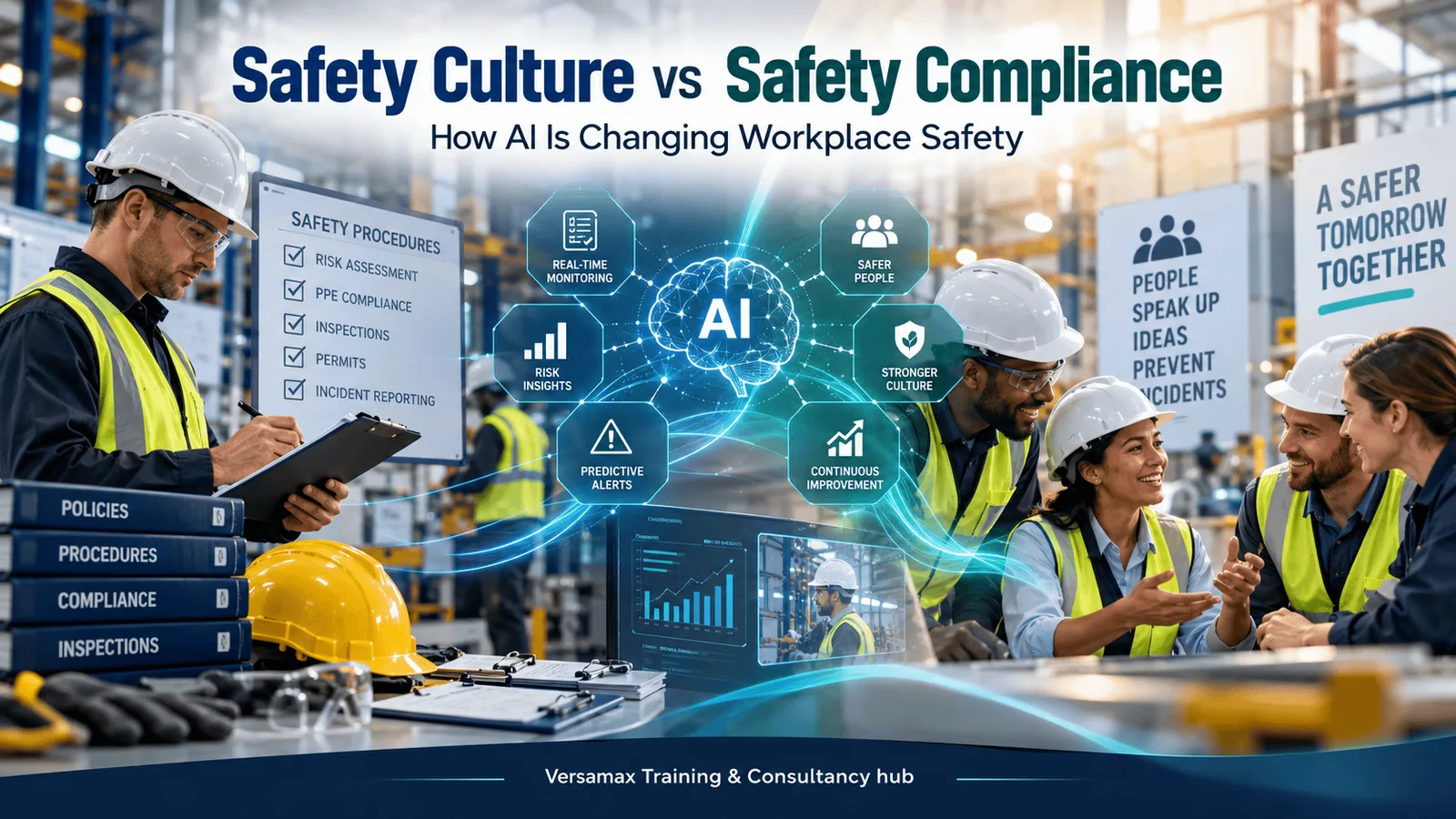
Creating safer workplaces is not only about following rules. It is about creating a culture where people genuinely care about one another, recognise risks early, speak up confidently and make safer decisions — even when nobody is watching.
Every employee deserves to return home safely at the end of the working day.
Yet workplace safety is often discussed mainly through policies, procedures, checklists, audits and legal requirements. These are essential. They provide structure, establish expectations and help organisations meet their responsibilities. But a truly safe workplace needs something more. It needs safety culture.
And today, with the responsible use of Artificial Intelligence, organisations have new opportunities to understand workplace risks, identify patterns and strengthen that culture. At Versamax Training & Consultancy Hub, we believe the future of workplace safety is not people versus technology. It is:
People + Safety Culture + Responsible AI — working together.
What Is Safety Compliance?
Safety compliance means following the laws, standards, company procedures and workplace rules designed to protect employees. Examples may include:
- Wearing required personal protective equipment
- Completing safety inductions
- Following safe operating procedures
- Conducting risk assessments
- Reporting incidents
- Maintaining equipment
- Completing mandatory training
- Keeping safety documentation
- Following emergency procedures
- Complying with applicable workplace safety requirements
Compliance is extremely important. It provides the minimum framework an organisation needs to operate safely and responsibly. However, there is an important question:
What happens when the supervisor is not watching?
An employee may wear safety equipment during an inspection because the rules require it. But will that employee make the same safe decision when working alone? That is where we begin moving from safety compliance to safety culture.
What Is Safety Culture?
Safety culture is about the attitudes, behaviours, values and everyday decisions people make regarding safety. It can be seen in the way employees talk about safety, in how supervisors respond when someone reports a problem, and in whether workers feel comfortable saying: “Something doesn't look right.”
A strong safety culture exists when people do the safe thing not simply because a policy tells them to, but because they understand why it matters.
Imagine an employee notices liquid on the floor. There is no manager nearby. There is no inspection taking place. The employee could simply walk around it and continue working. But instead, they stop. They secure the area. They report the hazard. They make sure somebody else does not get hurt.
That simple action represents safety culture. It says:
“Someone else's wellbeing matters to me.”
That is much more powerful than a rule written in a manual.
Safety Compliance and Safety Culture Are Not the Same
An organisation actually needs both.
Compliance asks: Are we following the required rules?
Safety culture asks: How do our people think and behave when making everyday safety decisions?
Compliance might tell an employee: “You must report a near miss.” A healthy safety culture encourages that employee to think: “Reporting this could prevent somebody from getting hurt tomorrow.”
Compliance provides the framework. Culture gives that framework life.
Small Things Can Become Big Things
Many workplace incidents do not begin with one dramatic mistake. They often begin with something small:
- A cable across a walkway
- A wet floor left unattended
- A damaged electrical plug
- A forklift travelling slightly too fast
- An employee removing a safety guard because the job needs to be completed quickly
- A worker deciding: “I've done this hundreds of times. Nothing will happen.”
And perhaps nothing happens today. Nothing happens tomorrow. Eventually, unsafe behaviour can start to feel normal. This is one of the greatest challenges in workplace safety: people become comfortable with risk simply because an accident has not happened yet.
A strong safety culture challenges this thinking. Instead of asking “Has anybody been hurt?”, it asks:
“What could happen if we continue doing this?”
That small change in thinking can prevent much larger problems.
Why Employees Sometimes Ignore Safety Rules
Most employees do not arrive at work intending to behave unsafely. Unsafe behaviour can develop for many reasons:
- There may be production pressure
- There may be insufficient training
- The employee may have become too familiar with the task
- The procedure may be complicated
- A supervisor may unintentionally encourage speed over safety
- People may believe that reporting a problem will create trouble
- Workers may simply think: “This is how we have always done it.”
That means safety training should not only explain what employees must do. It should help them understand:
- Why do we take shortcuts?
- What influences our decisions?
- What happens when unsafe behaviour becomes normal?
- How can we respectfully challenge unsafe practices?
- How can supervisors create an environment where employees speak openly?
This is where behavioural safety and safety culture become particularly valuable.
Moving From Reactive Safety to Proactive Safety
Some organisations mainly respond after something happens. An accident occurs. Then there is an investigation. A report is written. Corrective actions are implemented. This work is necessary. But the stronger question is:
Can we identify the warning signs before the accident happens?
This is the difference between being primarily reactive and becoming increasingly proactive. Near misses can be especially valuable. A near miss is a warning — nobody may have been injured, but something almost happened. Instead of being relieved and forgetting about it, organisations can ask:
- Why did this happen?
- Has something similar happened before?
- Could it happen somewhere else?
- What needs to change?
And increasingly, this is an area where Artificial Intelligence can support safety teams.
How AI Is Beginning to Change Workplace Safety
Artificial Intelligence should not be viewed as a replacement for HSE professionals, supervisors or workers. Safety requires human experience, judgement, empathy and responsibility. But AI can become a useful assistant.
Consider a company that receives hundreds of safety observations, near-miss reports and incident descriptions every year. A safety professional may need considerable time to manually review all of them. AI tools can potentially help organise that information and identify recurring themes. For example:
- January: Worker nearly struck by forklift
- February: Pedestrian entered loading zone
- March: Forklift reversed near employee
- April: Near miss at warehouse crossing
- May: Employee reported poor visibility near loading bay
Individually, these appear to be separate reports. But when reviewed together, a pattern begins to appear:
Repeated vehicle–pedestrian interaction risk.
That insight can encourage management to investigate:
- Pedestrian routes
- Forklift routes
- Visibility
- Signage
- Speed limits
- Barriers
- Loading procedures
- Supervisor practices
- Driver training
AI did not make the safety decision. It simply helped people see the pattern more clearly. That distinction is important.
AI Should Support People — Not Replace Them
At Versamax Training & Consultancy Hub, we believe responsible AI should strengthen human decision-making. The model is simple:
- People provide experience
- Employees provide observations
- Safety professionals provide judgement
- Management provides leadership
- AI helps organise and analyse information
Together, these can create better safety conversations. A useful principle is:
AI can identify patterns. People must decide what those patterns mean and what action should be taken.
Technology should never remove accountability from people.
Practical Ways AI Could Support Safety Teams
AI can potentially assist organisations in areas such as:
Near-Miss Analysis
Large numbers of reports can be grouped into common themes to help identify recurring risks.
Incident Trend Analysis
Historical incident information can be reviewed for repeating locations, activities or contributing factors.
Safety Training Support
Training material may be adapted for different roles, departments or levels of experience.
Toolbox Talk Preparation
Safety teams can use AI to help organise discussion topics based on workplace risks.
Safety Communication
Complex information can be converted into simpler language or structured communication for different employee groups.
Risk-Assessment Support
AI may help teams organise information and identify questions that should be considered during risk assessments.
However, AI-generated information should always be reviewed by a competent person. Safety decisions should never be blindly delegated to technology.
What AI Cannot Replace
There are things technology cannot replicate easily. AI cannot genuinely care whether an employee returns home safely. People can.
- AI cannot replace the trust between an employee and a supportive supervisor
- AI cannot walk through a workplace and understand every human factor simply from numbers
- AI cannot replace leadership
- It cannot replace accountability
- It should never replace professional safety judgement
The future of safety should therefore not be Human OR AI. It should be:
Human judgement + Responsible AI.
The Role of Leadership
Safety culture starts strongly with leadership. Employees watch what leaders do. Imagine a manager repeatedly saying: “Safety is our number one priority.” But when production falls behind, that same manager tells employees: “Just get it finished quickly.”
Employees notice the difference between words and behaviour. Culture is shaped by what leaders consistently demonstrate. Good safety leadership means:
- Listening to employees
- Encouraging reporting
- Responding respectfully to concerns
- Avoiding blame where learning is more appropriate
- Recognising positive safety behaviour
- Providing appropriate training
- Following the same rules expected of employees
- Acting on genuine safety concerns
When leaders take safety seriously, employees are more likely to do the same.
Psychological Safety Matters Too
Employees must feel able to speak. Imagine a new worker notices something unsafe but thinks: “Everyone else seems comfortable with it. Maybe I shouldn't say anything.” That silence can allow risk to continue.
A healthy workplace gives employees confidence to ask questions such as:
- “Can we stop for a moment?”
- “Is this the safest way to do this?”
- “I noticed something that concerns me.”
Speaking up should not be considered weakness or troublemaking. It can be an act of responsibility. A mature safety culture welcomes respectful questions.
From Training Attendance to Behaviour Change
Training should not simply be: Attend → Sign → Receive certificate → Forget. Training should create conversation. Employees should be able to relate the content to their actual work. A meaningful safety workshop should encourage participants to ask:
- What unsafe behaviours have become normal in our workplace?
- What risks do we regularly walk past?
- Do employees feel comfortable reporting mistakes?
- What does management do when somebody raises a concern?
- Are we learning from near misses?
- Could technology help us understand our safety information better?
When training creates this type of discussion, it becomes more than compliance. It becomes part of culture change.
A Simple Safety Culture Question
Here is one question every workplace can ask today:
“What is one unsafe behaviour we currently accept simply because nothing bad has happened yet?”
Ask employees. Ask supervisors. Ask managers. The answers may surprise you. Sometimes improving safety begins not with expensive technology, but with one honest conversation.
The Future: Human-Centred Safety Supported by AI
Artificial Intelligence will continue to develop. Workplaces will become more connected. Safety teams will have access to larger amounts of information. But the purpose of workplace safety should remain very human: protecting people.
Technology has value when it helps us do that better. The future workplace may use AI to discover patterns, technology to analyse reports and digital systems to improve training. But ultimately, safer workplaces will still depend on people who care enough to notice, speak, listen, learn — and act.
Where Does Your Organisation Stand?
Consider these questions:
- Do employees report near misses?
- Do supervisors welcome safety concerns?
- Are repeated incidents analysed for patterns?
- Do employees understand why procedures exist?
- Is safety discussed only after something goes wrong?
- Does management listen to frontline employees?
- Are unsafe shortcuts becoming normal?
- Could your safety data provide insights you are currently missing?
- Is your organisation ready to use AI responsibly to strengthen safety decision-making?
If some of these questions are difficult to answer, that is not a failure. It is an opportunity to begin a conversation.
How Versamax Training & Consultancy Hub Can Support Your Organisation
Versamax Training & Consultancy Hub helps organisations move beyond simply completing training requirements towards building stronger workplace behaviours and safety culture. Our approach can bring together:
- Workplace Safety
- Human Behaviour
- Safety Leadership
- Practical AI Awareness
- Continuous Improvement
Our workshops can be designed around the real challenges faced by your employees, supervisors and management teams. Rather than beginning with “Which course would you like to purchase?”, we prefer to begin with:
“What workplace challenge are you trying to solve?”
From there, we can explore the most appropriate training and development approach for your organisation.
Build Safety Beyond Compliance
A safe workplace is not created by policies alone. It is created through thousands of small decisions made every day. A supervisor who listens. An employee who reports a near miss. A manager who chooses safety over unnecessary pressure. A team that learns from mistakes. And increasingly, technology that helps organisations understand those decisions more clearly.
- Compliance gives us the framework.
- Culture gives it meaning.
- People make it happen.
- Responsible AI can help us see what we may otherwise miss.
Let’s build workplaces where safety becomes more than a requirement — it becomes part of how people think, work and care for one another.
Ready to Start a Safety Culture Conversation?
Speak with Versamax Training & Consultancy Hub about a Safety Culture & AI Readiness Discussion for your organisation — corporate training in HSE & workplace safety, safety culture, leadership and AI-enabled workplace learning. Request a corporate training consultation today.
Ready to take the next step?
Versamax Training & Consultancy can help your organization implement these strategies with expert-led programs tailored to your needs.
Contact Us

